10.19.2010

The Convenience of Conservation

Sustainability? What’s that? 
(I’m just kidding.)

As a term that has become overused, overworked and cliché, “sustainability” now haunts us in our sleep, classes and everyday life. We are force fed daily doses of commercials, tv shows, news reports, and advertisements which advocate sustainable and responsible living, while sometimes guilting us (or deceiving us) into investing in “environmentally friendly practices.” The latest fad for advertisers seems to be adding the words, “energy efficient,” or “environmentally responsible” to their products, while the term “global warming” immediately begins a heated (no pun intended) global debate.
Don’t get me wrong; I sincerely think environmental living is important. I just think that there must be a more interesting and inviting way to portray it. 
It’s true that most people are completely out of touch with nature; it is extremely difficult these days to stay grounded in a natural environment when we have created an environment which is anything but natural. Concrete towers, glass and mirror buildings, faux wood panelling on the walls and the floors--all of these things are so clearly manmade, designed BY man FOR man, without concern for what else resides within or around a city. However, I don’t think that people are unaware of environmental concerns. I know that I make a conscious effort to recycle, to turn of the lights, to walk when possible or take public transit, to carpool and donate unwanted clothes and drive a fairly fuel-efficient car and turn off the tap and buy products with less packaging. In fact, for most people, this list could continue for days! Instead, I think the lack of interest in environmental initiatives like Sustainability Week revolve around the concept of “big changes.” Most people, myself included, aren’t interested in giving up their TV, grocery store, cell phone, shopping mall, and computer to move to the wilderness and become a tree hugger by day and food scavenger by night. In short, it is the convenience aspect which discourages people.
In most cases, we aren’t asked to give up our current lifestyles; we are just asked to adjust them according to the needs of the world as whole. However, there will always be those extremists who live in trees and never shower, which give the entire “sustainable living” idea a bad rap, especially to our possession-oriented culture.
In my opinion, the sustainability issue needs to take baby-steps with the public (even though the issue is becoming increasingly urgent.) Encourage us to recycle and do the small things first, until we get the hang of it--then move up to the bigger things, like solar panels as energy sources. 
Use interesting advertising techniques (such as the “Wanted: juice box outside City Hall” commercials), provide incentives do be earth-friendly (perhaps rebates for households who reduce their energy consumption) and make it easier for people to participate in otherwise difficult projects (like community compost initiatives). The government, in all of its forms, needs to take a stand too, by regulating emissions and encouraging environmentalism, even if it inconveniences the shareholders.  And finally, people need to become aware of the natural environment they are currently missing, even if that means planting a single tree outside a municipal building.
As it addresses an issue that affects everyone (whether they live in a bustling city or in a sheltered cave on a hillside), Sustainability Week should be an influential event for the University! And with an important civil election just ending in Edmonton (as well as in Calgary, my hometown), innovative sustainability should’ve been a frontrunner on each candidates agenda. It’s not that the public isn’t interested in sustainability; they just need a little encouragement. 

10.07.2010

Dust Bowl Disaffection

A lonely country crossing; a dusty haze sliding low along the ground; a solitary man with a purpose. Oh, I can almost feel the heat of the sun on my skin, the swish of the dust in my hair and the sting in my eyes! The opening scene of Grapes of Wrath is truly beautiful in its simplicity. Its careful imagery sets a desperate tone for the remainder of the film, while instantly capturing the viewer’s interest. 
Normally, I am not a fan of black and white movies. There’s something about KNOWING that the sky should be blue, but instead seeing a shade of grey just shy of white that plays tricks with my mind; I am instantly apathetic, no matter what else a film has to offer. However, in this one, special, case, I found that the lack of colour truly contributes to the grey, hard life which the Joads have been forced to lead. It is not that they do not know happiness; instead, the black and white serves as a sort of contrast between the happiness they must have known and the dullness they are now experiencing. 
The distinction between the shadows and candle light in the Joad’s recently abandoned house is especially interesting. The whites of their eyes are so clearly visible, and the emotion within them seems magnified by hundreds of times just because we are forced to focus on their unhappiness. 
These contrasts carry on throughout the film, sometimes to the point where you cannot see much at all besides a black screen and the quick flick of a candle or flashlight as a character moves from scene to scene. In these places, the music, or lack of music is also interesting. For the majority of the movie, and definitely within the most crucial scenes, there is no music whatsoever. While at times this causes the viewer to lose interest or understanding, at other times it helps to emphasize the desperate nature of the film.
Despite all of the positive cinematic qualities that this movie possesses, I found myself disappointed at the end. For the majority of the movie, I was confused by its purpose; there just didn’t seem to be a true, cohesive plot which carried through the whole movie. Or if there was a plot, it just didn’t seem to have the suspense or excitement needed to carry the movie along in an interesting manner.
While portraying life in the Depression, specifically in the Dust Bowl region, appropriately and accurately, Grapes of Wrath just wasn’t able to hold my attention with its story line.
Regardless of my movie critique, I feel like you really have to admire the Joads. Their life hasn’t been easy, and probably won’t get easier anytime soon. While their accompanying story wasn’t my favorite, the essential message within the story really struck a cord with me, and probably with other viewers based on its popularity. It’s a story of determination and hope, of struggle and of wandering, and lastly a story of home. “We'll go on forever, Pa, 'cause we're the people,” said Ma Joad, and you can’t help but believe her. 

10.01.2010

Students Aren't Stupid

There are 26 letters in the English language.
According to my grade one teacher, 6 of these are eligible as vowels, and, according to my linguistics professor, approximately twelve spoken vowels exist.
Give or take a few thousand either way, there are 988 968 words in the English language, based on research conducted by the Global Language Monitor.
There are only so many ways to "make" words; the possibilities are finite, limited by phonetics, meaning, and grammar. By this logic, there are only so many ways that words can be put together in sentences and paragraphs before we start to repeat ourselves and one another's words. What a disheartening and depressing observation..
And yet, we do not know, realize, or, for the most part, care, when we duplicate our phrasing or the phrasing of others. Instead, it is the ideas present within the phrasing that seem to hold the most value--even though there are finite possibilities for these also! It's very possible that I have never (ever) had a truly original thought in my entire life.
Up until this realization, I thought I was unique, at least to a certain extent--but this doesn't bother me. Want to know why? I don't care! My thoughts are my own, and I don't care who thought them "first," or who will think them "next," or how many people have thought them before me. My ideas are my own.
I realize that I'm only a lowly undergrad, who hasn't even completed her first English course. And yet, the "great" and "famous" people whose ideas I must "quote" were once the same age as me, in the same stage of their life, with as little (or even less) experience. It is the opportunity to BE great which has made their words GREAT, and these opportunities exist and are available to everyone.
To pass my English course, I will dutifully scratch out the names and locations of various facts and quotes throughout my essays. But, no matter how many people I must reference or how many texts I must search through to find a reference, the thoughts within my papers will only be my own. Their quotes may support my ideas--but they are not the same. There is a reason I am writing what I am writing--because I believe in it.

9.24.2010

Nuclear and Nimrods


To stand on the shore and look at the ocean, you would think that it simply goes on forever. And, as far as our eyes can see, it does. It is a blank canvas, an open stretch of nothing and everything that both begins and ends with where we stand right now. But, as rational and scientific human beings, we know that this is not the case: continents, islands and large sea ice floes are scattered throughout, although they are not visible from where we stand. But what if our perception was, to an extent, true? What if we could stand on the northern shore of Russia, look directly ahead, and know that it is a simple straight shot to North America? What if there was nothing that stood in our way? Some scientists predict that there will be NO sea ice remaining by the summer of 2030, making this a very real and very imminent possibility. 
And, so far, the Russians haven’t wasted any time capitalizing on this new development. With huge oil and gas resources waiting just off their shores, floating nuclear power plants have already been built to power the oil and gas expeditions. The lack of ice has opened up numerous possibilities for the Russians, not only in terms of drilling for oil but also for transporting it to “energy-hungry” economic superpowers such as China. 
The opening of the ice will make it easier for the Russians to transport fuel, but it is important to remember WHY this is possible. Global warming, and the effect that it has had on the Arctic environment, has ultimately led to this new economic opportunity. Ironically, a direct cause of global warming is the burning and usage of fossil fuels. If this plan goes ahead, the Russians will both make and break their fortune in one swift blow--they will be able to transport and drill for fuel, but, in doing so, they will be destroying the environment further. 
And while we’re worrying about the environment, lets not forget about the nuclear power stations needed to power these exploits. While Russian scientists say they can “guarantee the safety of [their] units one hundred per cent,” it is easy, and perhaps necessary, to be slightly skeptical of their claims. This is coming from the home of the Chernobyl nuclear disaster, one of the worst nuclear power plant disasters in history, and one can only imagine the effects of a similar disaster on an already fragile and deteriorating Arctic environment.
Along with the potential danger to the marine life and their habitat, there is also the human aspect to consider. If a nuclear power plant was to explode (“unlikely," according to the Russians), wouldn’t it explode right above the oil and gas reserves that are being exploited? Wouldn’t this already disastrous explosion be magnified many times over just by the presence of such a flammable and dangerous substance? And what about the people who must be present to operate these machines? The risks associated with working in a nuclear power plant are already numerous--adding oil and gas to the mix would only amplify them!
In a world driven by money, money, and the potential for more money, I don’t find it surprising that the Russians are eager to capitalize on this opportunity. Luckily, they have met some resistance--although not in terms of environmental protection. Instead, the battle has begun over which country has legal rights to the oil and gas reserves! We can only hope that this conflict continues long enough for someone (anyone!) to stand up and question this endeavor, in an effort to protect and prolong the life of the Arctic habitat.

9.15.2010

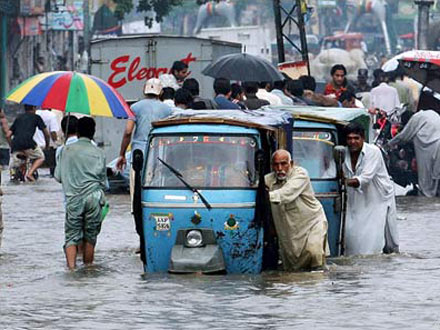
Pakistani Perplexity

For me, the debate is not SHOULD we help; that is a given. Instead, I wonder to what extent help should be given to countries in need. On one hand, I think it is important for countries to be able to support themselves based on the resources available to them. However, the ability of countries to do so usually depends on the competency of governments, as well as the amount and type of resources available to each country. A less developed country like Pakistan may already be experiencing economic disadvantages, and this unavoidable disaster has only added to its problems. 
However, it is important to note that the rest of the world is also experiencing economic crisis; people are (somewhat selfishly) holding onto money to fund their own families. We are all world citizens and members of the global community, and yet we feel as though we must take care of ourselves before we can take care of others. And to add to this conundrum, the global community is experiencing further economic uncertainty. We still do not know when the economic crises will be alleviated, and so society feels as though money needs to be conserved and saved for the future--no unnecessary expenses (although I’m sure that the Pakistani people would certainly disagree!).
Despite the many varying excuses for NOT giving, I feel like there are so many more important reasons to aid in Pakistan’s recovery. Regardless of race, language, and religion, these people are experiencing hardship which we cannot imagine, not even in our nightmares. We live in a beautiful, prosperous and generally forgiving country, but we need to learn how to be global citizens instead of just members of the local community. Global support will not only help to provide for Pakistan; it will also contribute to the wellbeing of the global community as a whole, socially, culturally and economically. If one country struggles, we all face the consequences as an interconnected and co-dependent community. And who are we to say that we cannot help another country because we are too busy helping ourselves? There is no reason why, in a few years, we could not be in Pakistan’s position, with a natural disaster threatening everything that we have built and worked towards. Our selfishness will not be able to save us then. Only by creating and nurturing friendly ties with our global community can we ensure our own survival through the good times as well as the bad. As the Beatles so famously said, “I get by with a little help from my friends.” 
After considering this, I truly think that we must learn to give up some of our own comfort and luxury to help Pakistan. I do not think that it is solely the job of the global community to restore Pakistan’s former standard of living; the local government must be responsible for some of the re-building. However, without input from Canadians and other world citizens with the monetary means to help, Pakistan (nor any other disaster-plagued country) will ever be able to recover.